
Proof of Work for Remote Contractors: How Agencies Bill Confidently
An agency invoice for 340 hours is worth exactly as much as the evidence behind it. When a client asks what those hours produced, the answer is either a record or an argument — and arguments cost money in both directions.
The Association of Certified Fraud Examiners puts business losses to billing disputes and time theft at around 5% of annual revenue, and more than 60% of late invoice payments trace back to administrative errors or disputes rather than client cash-flow problems. Agencies that adopt remote employee tracking software usually do it after a specific painful invoice, and usually configure it for the wrong thing: they capture everything, when what settles a dispute is a narrow set of records tied to the contract.
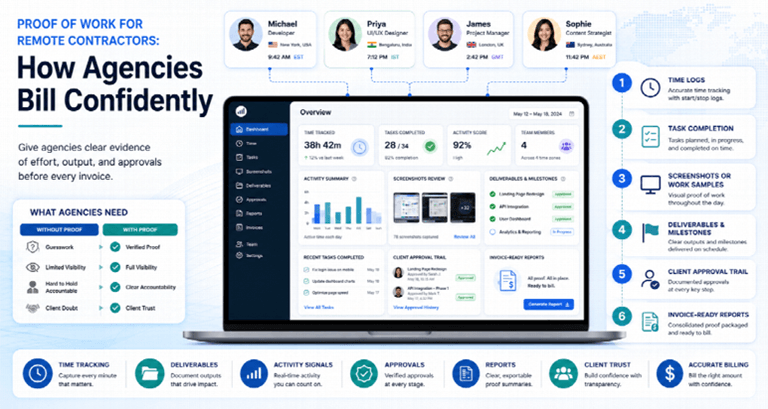
What actually counts as proof
No single artifact convinces a skeptical client. Proof of work is layered, and each layer answers a different objection.
| Layer | Answers | Strength |
| Tracked time | Were these hours worked | Weak alone — a timer proves nothing about the work |
| Activity levels | Was the person actually at the machine | Medium — rebuts “the timer ran while nobody worked” |
| Application and URL logs | Was the time spent on this project | Strong — shows the right tools were open |
| Screenshots | What was being done | Strongest for disputes, weakest for privacy |
| Deliverables | What the hours produced | Decisive, but only at completion |
| Project attribution | Which client the hours belong to | Essential for any multi-client agency |
The pattern worth internalizing: time logs establish the claim, activity and application data support it, screenshots settle it, deliverables close it. Agencies that rely on the first layer alone lose disputes they should win.
Note what makes screenshots uncomfortable. They are the most persuasive evidence and the most invasive collection, which is why they belong in the contract rather than in a unilateral configuration decision.
Write the tracking terms into the contract.
Most billing disputes are contract failures that surface as evidence problems. Six clauses prevent the majority of them.
Definition of billable time. Does research count? Internal coordination? Revisions caused by the client changing scope? Travel? Ambiguity here produces disputes no amount of tracking data resolves, because the argument is about definitions rather than facts.
Tracking method and consent. State which tool, what it captures, and that the contractor agrees to it. Contractors work on their own equipment; installing monitoring without an explicit contractual basis is both legally exposed and relationship-damaging.
Screenshot terms, specifically. If screenshots form part of the evidence, say so — frequency, who can view them, retention, and whether sensitive screens can be excluded. This is the clause most often omitted and most often disputed.
Hour ceilings. A weekly or monthly cap that cannot be exceeded without prior approval. This single clause eliminates the surprise 60-hour week that arrives as a fait accompli.
Dispute process. What happens when the client or the agency questions billed hours: who reviews what, in what timeframe, with what evidence. Agreeing this before a dispute costs nothing; agreeing it during one costs the relationship.
Audit rights and retention. How long records are kept and who can request them. Match this to your payment cycle and the client’s audit habits, not to the software default.
Configure for evidence, not surveillance
The mistake agencies make is enabling every layer because the tool offers it. Contractors notice, and over-collection creates legal exposure without improving the evidence.
Track only during billable work. Session-based tools capture between clock-in and clock-out and nothing outside it. On a contractor’s own machine, this distinction is not a nicety — it is the difference between a defensible arrangement and an indefensible one. Monitask captures only between clock-in and clock-out, and records no keystroke content; activity levels derive from whether input occurred within each ten-minute window.
Attribute time to projects at capture. Retrospective attribution is guesswork. Every entry should carry a client and a project when it is created.
Set screenshot frequency to the dispute risk, not the maximum. Thirty per hour is standard on most tools and adequate for nearly every case. Monitask includes 30 per hour and charges $2.40, $4.80, or $7.20 per license for 60, 90, or 120 — buy the higher rates only where a specific client demands them.
Skip keystroke capture entirely. It adds nothing to billing evidence and adds substantial compliance obligations. Most tools in this category no longer offer it, and around 46% of technical workers say they would decline work under it.
Check retention against your payment cycle. This is the setting agencies get wrong most often. Entry tiers commonly retain one to two months — Monitask holds one month on Pro and two on Business. If a client disputes an invoice 90 days after delivery, one-month retention means the evidence no longer exists. Size the plan against your dispute window, not your headcount.
Handling a dispute, in order
When a client challenges an invoice, the sequence matters. Leading with screenshots looks defensive and escalates the issues.
- Confirm what is actually being disputed. Total hours, the rate, whether specific work was in scope, or the value delivered. These need entirely different responses, and clients often conflate them.
- Send the time breakdown by project and task. Most disputes end here. The client wanted to understand the invoice, not challenge it.
- Add application and activity context if questioned further, which tools were in use during those hours, and the activity levels. This rebuts the “timer left running” objection without showing anyone’s screen.
- Offer screenshots only if the dispute persists and the contract covers them. Frame it as making records available rather than proving the client wrong.
- Tie hours to deliverables. Ultimately, what closes a dispute is the connection between time and output. A client who accepts that the work was done rarely continues arguing about the hours it took.
- Adjust where the evidence supports the client. If the records show over-billing, correct it and document why. Agencies that only ever defend look like agencies with something to hide.
Distinguish incidents from patterns. One discrepancy is a conversation. Repeated discrepancies mean the tooling, the agreement, or the relationship needs changing.
When the evidence works against you
Worth planning for, because it happens.
The data shows fewer hours than invoiced. Correct it immediately and voluntarily. Discovery by the client costs far more than the adjustment.
Activity levels look low on legitimate work. Client calls, whiteboard sessions, and reading register as idle. If your client sees raw activity scores, they will ask about this — which is a good argument for sharing time and deliverables rather than activity percentages.
Screenshots capture something awkward. Personal browsing during a paid session, or a competitor’s file open. This is why contractors should be able to exclude sensitive screens and why blanket screenshot sharing with clients is a bad default.
Tracked time reveals your margins. A client who sees that a $12,000 deliverable took 40 hours can calculate your effective rate. Share hours at the level the contract requires, not the maximum level the tool permits.
What proof of work does beyond disputes? Dispute defense is the reason agencies buy it. The returns usually come from elsewhere.
Estimation accuracy. Knowing a category of work genuinely takes 26 hours rather than the 18 you quote fixes margins permanently. This compounds across every future proposal.
Detecting overruns while they are still fixable. A fixed-price project budgeted at 100 hours that hits 80 with 30% of the work remaining is a problem you can still address — if you see it in week three rather than at delivery.
Faster payment. Since most late payments stem from administrative disputes rather than client cash flow, invoices that arrive with their justification attached get approved faster. Fewer clarification emails, fewer approval cycles.
Contractor protection. Worth stating plainly, because agencies rarely frame it this way to their contractors: verified records protect the person doing the work as much as the person paying for it. Documented hours end the “that took you how long?” conversation permanently.
Scale awareness. One reported deployment across 500 contractors at a US bank surfaced a 25% gap between billed and actual work, with $2.5 million saved within three months. That figure comes from the vendor and should be read as illustrative rather than typical — but the direction is consistent with what agencies find at smaller scale.
What to share with clients, and what not to
The most common error is over-sharing, which creates problems that did not exist.
Share by default: hours by project and task, weekly or monthly summaries, deliverables tied to time, and budget-versus-actual against the estimate.
Share on request: application-level activity summaries, activity level averages with an explanation of what they measure.
Share only when the contract requires it: screenshots, individual contractor detail, real-time dashboards.
Never share: contractor personal data, activity from other clients’ work, or raw screenshot archives.
Client-facing access is a real feature in several tools — Monitask includes client login from its Business tier — but access should be scoped. A client portal showing everything the agency sees is a portal showing your capacity, your other work patterns, and your margins.
Frequently asked questions
What counts as proof of work for contractors?
A layered record: tracked time attributed to projects, activity levels showing engagement, application and URL logs showing the right tools were in use, optionally screenshots, and the deliverables those hours produced. No single layer is convincing alone.
Can I require contractors to use monitoring software?
Yes, when the contract states it before work begins — which tool, what it captures, and the contractor’s agreement. Contractors typically work on their own equipment, so installing monitoring without an explicit contractual basis is legally exposed regardless of the business justification.
How long should agencies keep time records?
Long enough to cover your longest realistic dispute window plus the client’s payment terms, which usually means more than the one to two months entry-tier plans retain by default. Check this before buying — evidence that has been auto-deleted cannot be recovered.
Should clients see contractor screenshots?
Only where the contract specifically provides for it. Screenshots are the strongest evidence and the most invasive collection, and routine sharing exposes contractor privacy, other clients’ work, and your own margins. Share hours and deliverables by default.
What if a client disputes hours we can prove?
Work through it in order: clarify what is disputed, send the project-level time breakdown, add application context if pressed, and offer screenshots last. Most disputes resolve at step two because the client wanted to understand the invoice, not challenge it.
Do activity levels prove productivity?
No. Activity measures whether keyboard or mouse input occurred, so calls, reading, and planning register as low. It rebuts the specific objection that a timer ran unattended — nothing more. Presenting it to clients as a productivity measure invites arguments you will lose.
How do I stop contractors over-billing without micromanaging?
Set an hour ceiling requiring prior approval, attribute time to projects at capture, and review against budget weekly rather than daily. The ceiling prevents surprises structurally, which is more effective and less corrosive than monitoring individual days.
Is proof of work worth it for small agencies?
The break-even is usually one dispute. At $6–10 per contractor monthly, a five-person agency spends $30–50 to protect invoices worth thousands. The estimation improvement typically returns more than the dispute protection does.
Popular on OTW Right Now!




About The Author

Gagan Bhangu
Founder of otechworld.com and managing editor. He is a tech geek, web-developer, and blogger. He holds a master's degree in computer applications and making money online since 2015.