
Why a skid steer flail mower throws far less debris than a rotary blade
Mowing where people and property are close by
In the United States, an enormous share of vegetation management happens within a few feet of something that can be damaged or someone who can be hurt. State departments of transportation mow tens of thousands of miles of roadside shoulder every season, often with traffic passing only a lane away. Parks, school grounds, and utility easements share the same problem: the grass must be cut, but the area beside it is full of cars, windows, and people.
This is the working world a flail mower was built for, where how the machine behaves when it strikes a hidden rock matters as much as how cleanly it cuts grass.
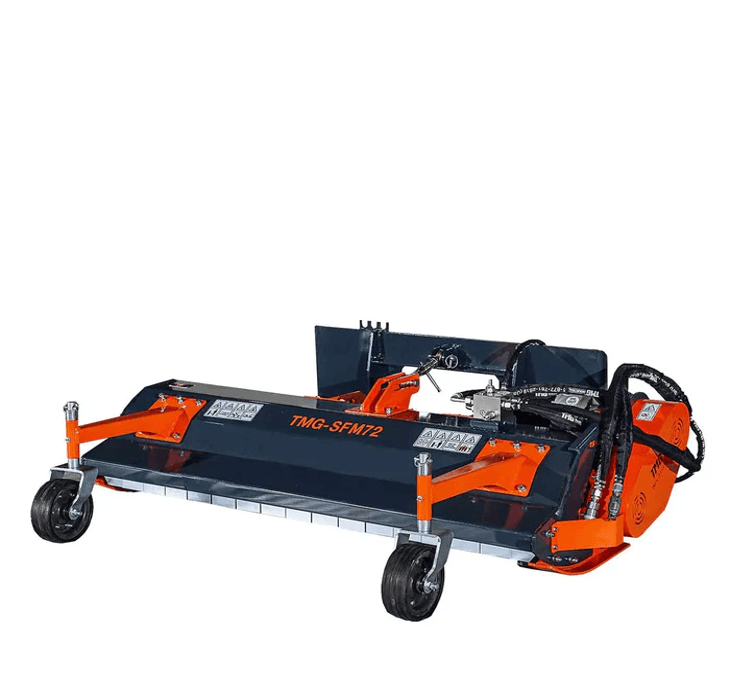
This is the most distinguishing feature of this tool – its behavior on impact. A rotary cutter and a flail encounter the same hidden dangers, but in different ways, and the nature of that difference determines the location of each.
The physics of a blade that gets out of the way
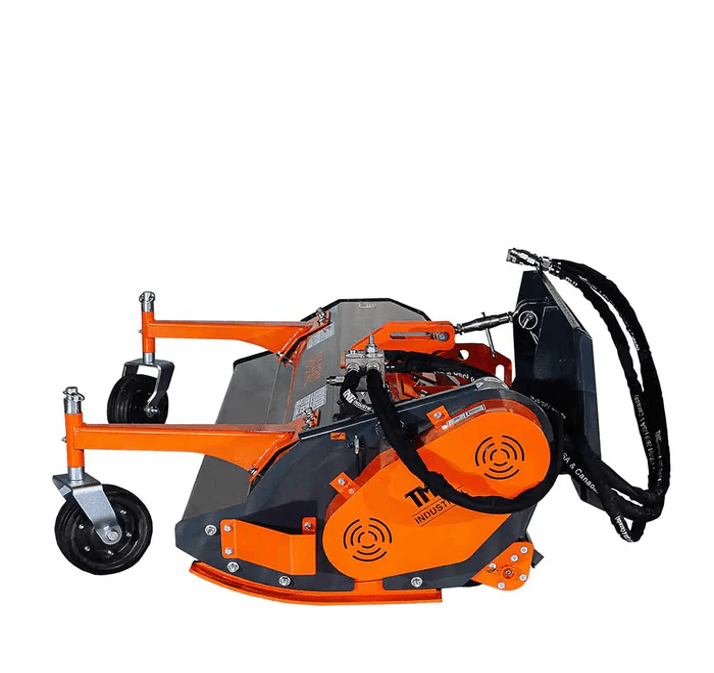
Flail mowers have cutting edges that are numerous tiny blades attached to a freely pivoted end of a rapidly rotating drum. Imagine that each of the blades is a pivoting knuckle, not a rigid knife. As it whirls through grass, it is held straight by centrifugal force and cuts cleanly. The blade folds back on its pivot and swings clear when it comes in contact with a solid object such as a piece of concrete or a steel survey stake.
It’s all in the folding. The little blade is attached to the hinge, but the energy of the collision is not used to push the object across the road but to swing the little blade back on the hinge. The obstacle is just a little disturbed, the blade rides over it,t and the next moment the blade is thrown back out to continue cutting.
How a rigid blade turns a rock into a projectile
The rotary cutter is the reverse of this. The blade is firmly fastened to the spinning disk and thus is not capable of yielding. As this stiff blade collides with a rock, the rock can’t bend the blade away, ay and most of the energy of the blade is transferred directly to the rock. The outcome of this is a high-speed object which is thrown out under the deck at times far enough and fast enough to break a windshield or injure a bystander.
The two tools can be classified best by the way the blade is engaging an obstacle. The flail mower has a hinged edge which retracts while the rotary has a rigid edge which strikes through. Their trim design and the rumbling speed of the rotary just pour out of that one mechanical decision.
- Hinged blade folds back and absorbs the hit
- Rigid blade transfers energy into the object
- Free pivot is what limits thrown debris
Reading the same trade-off from both sides
This hinged design isn’t free. A flail requires more passes on heavy brush; it requires more power to make its loaded drum turn, and, due to its small size, has less productivity per hour. That might sound like a disadvantage as you read; you’re reading from a contractor that’s mowing acres of open field, and a rotary cutter’s speed comes out on top.
One example in the highway maintenance industry is the mandating of flail-type mowers for mowing medians and shoulders in many states because of the minimized liability and risk for a crash to occur from thrown objects. Preventing the incident that caused the job to be stopped altogether is the reason that the mower cuts a little slower.
Matching the tool to the ground
In addition to safety, the hinged blade will also deal with varied and trashy ground without any problems. A flail mower will handle wire, brush, and small saplings, as the blades bend and will not break, and will provide a more even, mulched finish than rigid blades, which lie in heavy windrows and are difficult to break down. On a skid steer, the attachment is a good solution for finishing work, ditch banks, and any situation where appearance is important.
- Choose hinged cutting near people and traffic
- Choose rigid cutting for open, fast field work
For any operation that mows where a thrown rock would be unacceptable, a flail mower trades a measure of speed for a margin of safety that is well worth the exchange.
Understanding the tool at the level of a single hinged blade turns a purchasing question into a clear one. The job is not only to cut grass but to control what happens at the moment of impact, and that is exactly the moment the flail was designed around within modern vegetation management solutions.
Popular on OTW Right Now!




About The Author

Gagan Bhangu
Founder of otechworld.com and managing editor. He is a tech geek, web-developer, and blogger. He holds a master's degree in computer applications and making money online since 2015.