
Currency Fragmentation Is Quietly Rewriting the Rules of Global Payroll
For most of the last fifty years, moving money across borders was a solved problem. A company in one country wired dollars, correspondent banks passed them along, and an employee on the other side of the world was paid. Plumbing was hidden, and the finance staff didn’t have much to think about it. These days are coming to a close, and a change is coming that will impact everything, including that monthly payroll run.
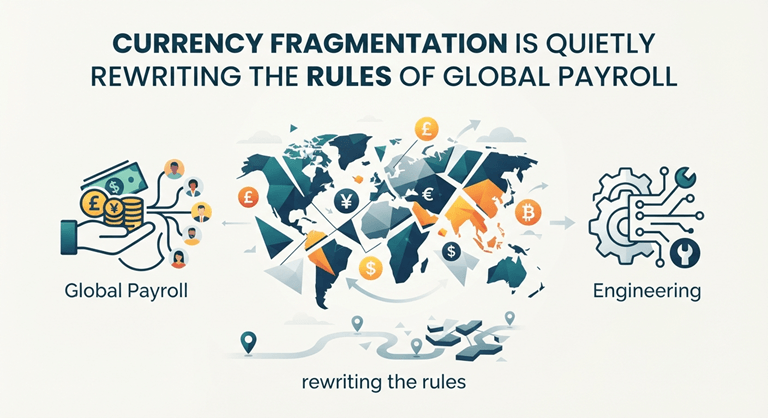
The transition is awkwardly called “de-dollarization”, but the situation is more easily explained. A growing share of global trade and settlement is shifting from one predominant currency and its messaging system to regional currencies, bilateral arrangements, and alternative clearing systems. These are all part of a culmination of measures that have been taken so far with the aim of making China’s cross-border interbank system more effective, introducing local-currency swap lines between central banks, and continuing the renminbi’s increasing use in trade settlement. But the world isn’t going to stop using the dollar; it’s just creating parallel tracks.
Why payroll teams should care
This appears to be a macroeconomic play for the treasury desk and central bankers, rather than HR. However, it’s when the currency policy is combined with an individual bank account that fragmentation becomes an operational issue with payroll.
A business can virtually pay any virtually anyone virtually anywhere with a predictable fee and arrival time, when settlement is through one universally accepted system. If settlement breaks down into blocs, this predictability is lost. Some hallways get slower. Some hallways slow down. Others get more costly. Some are quite problematic,c and specific banking connections, currencies, and compliance procedures are needed to enable a legally and practically viable salary to be deposited into an employee’s account.
What’s the payoff is ‘where do we pay this person, and how ‘, once more a back-office detail. This is a question that may mean the difference between a successful hire and one that is impossible to make.
Corridors, not countries
What finance leaders need to change is their perspective on countries nd move to thinking in terms of corridors — the particular path that money follows from the funding source to the employee. The situation is different for two companies based in the same country, depending on the country from which they receive their capital and the currency in which it is issued.
One of the most challenging corridors in the world today is to fund a workforce in an economy that is the subject of a lot of sanctions in one currency, in an economy that is not in the same currency bloc. The mechanics of paying a team in Russia from China illustrate the general problem in a concentrated form — restricted Western channels, cautious correspondent banks, local-currency settlement through alternative clearing systems, and a compliance burden that has to be handled before a single salary moves. It’s an extreme example, but the trend — the path is as important as the destination — is becoming more common than not.
What finance leaders can actually do
Three disciplines separate companies that navigate this well from those that get caught out.
Map your corridors before you hire. Before making an offer in a new market, work out the entire journey the funds will follow: from where they come, where they are going, in what currency, and through all the institutions in between. When it comes to payroll, you don’t want to find out about any of the links before you have to pay.
Treat compliance as a precondition, not a formality. When a settlement is divided up, the rules are too. Screening for sanctions, know-your-counterparty (KYC), and local currency-control regimes are not new phenomena but a regular routine in payroll, just like any other. It will be much more cost-effective to incorporate them into the process at the outset than to add them on as a rejection is received.
Consolidate rather than improvise. When you make international payments to each employee, each payment, it increases the risk and cost. It’s better to ensure that a single compliant local payroll structure is funded — typically via a specialist partner with established banking relationships and in-country systems — and that payment of salaries is made in the local currency in which they are paid.
The bigger picture
None of this casts any doubt on the ease of global hiring, as it doesn’t make it more difficult in ways that make it a bad idea. The talent recruitment skills to build international teams are becoming ever stronger. The difference now is that the financial infrastructure that supports those teams isn’t universal; it isn’t what it is in other places. Indeed, with currency fragmentation, the payroll function is becoming a strategic issue — a little thought regarding corridors and compliance to avoid a lot of hassle later. The companies that see this at an early stage will continue to pay their staff seamlessly, whereas other companies will wonder why they don’t get a wire.
Popular on OTW Right Now!




About The Author

Gagan Bhangu
Founder of otechworld.com and managing editor. He is a tech geek, web-developer, and blogger. He holds a master's degree in computer applications and making money online since 2015.