
How Zero Trust Network Access Reduces Lateral Movement Risk
Most security incidents do not end at the point of initial compromise. A phishing email, a stolen credential, or an exploited vulnerability gives an attacker a single foothold, but the real damage typically happens afterward, as that attacker moves from the system they first compromised toward the data and systems they actually want. This movement across a network, commonly called lateral movement, is the stage where a minor incident becomes a major breach.
Zero trust network access for applications was built with this exact problem in mind. By granting access at the level of individual applications rather than the broader network, and by treating every request as unverified until proven otherwise, this architecture closes off the pathways that attackers depend on once they gain an initial foothold. Understanding how lateral movement actually works and why zero-trust network access disrupts it so effectively helps explain why this model has become central to modern enterprise security strategy.
Why Lateral Movement Is So Dangerous
Lateral movement refers to the techniques attackers use to expand their access within a network after an initial compromise. Rather than stopping at the first system they breach, attackers use a combination of stolen credentials, network reconnaissance, and exploitation of trust relationships between systems to move toward higher-value targets, such as domain controllers, financial systems, or sensitive data repositories.
This stage of an attack is dangerous precisely because traditional network architectures make it relatively easy. Once a user or device is inside the network, whether through a compromised VPN session or a breached endpoint, that device is often implicitly trusted to communicate with a wide range of other systems. Attackers exploit this trust by harvesting credentials, querying internal directory services, and using legitimate administrative tools to blend in with normal network activity, making detection significantly harder.
Industry research underscores how widespread this challenge has become. A zero trust segmentation report found that the number of ransomware attacks doubled over a two-year period, with the vast majority of surveyed organizations identifying network segmentation as critical to thwarting these attacks, even though actual segmentation deployment across critical business areas remained slow.
How Zero Trust Network Access Disrupts the Pattern
Traditional remote access models are based on granting much wider network-level access after authentication, which is exactly what lateral movement requires: a flat traversable environment. Unlike zero trust network access, which operates on the network level, zero trust application access operates at the application level, brokering access with a completely different approach.
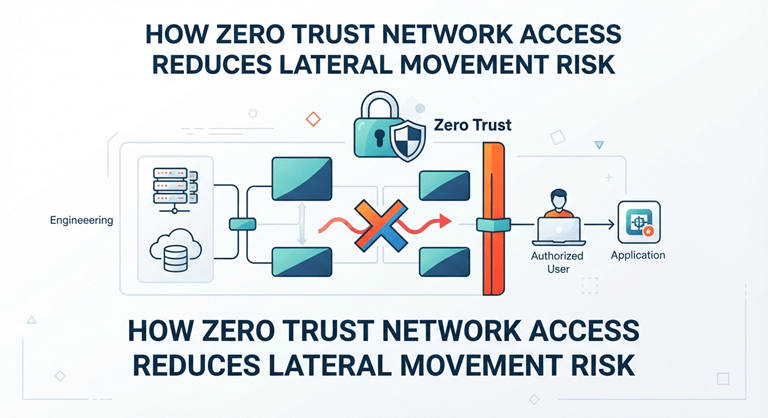
This model does not put a user who requests access to a certain application on the wider network. Rather, the connection goes through a policy engine where an identity, device posture, and context are checked, and a direct, narrowly scoped connection to that one application is created. The user doesn’t see it, and can’t get a network path to it, since this is not its intended design.
This directly impacts the movement from side-to-side. Under a zero trust network access model, if an attacker compromises just one set of credentials, they will only have access to the applications it was meant for, rather than a wide range of applications. There’s no internal network segment to scan, no adjacent system to pivot to, and no trust relationships that lateral movement relies on; it just doesn’t exist in this architecture.
Application-Level Segmentation as a Core Defense
Network segmentation, traditionally based on VLANs, subnets, and firewall rules,s is one of the most effective ways to reduce the extent of the blowback of a compromise, yet it is often complex to design, costly to implement and maintain, and prone to gaps as networks change over time. Zero trust network access provides the same benefits as segmentation, but in a more granular and more sustainable manner, by enforcing access policy at the level of individual applications, not the broad network zones.
This is a significant distinction if it is important to restrict lateral movement. If an attacker is successful in penetrating a coarse network segment, he or she could still access dozens of systems after gaining entry, but with an application-level access policy under zero trust network access, he or she could be limited to a limited and well-defined resource. The enforcement model is itself the segmentation without having to continuously redesign network topology as the infrastructure of the organisation evolves.
For a structured view of how this fits into a broader security strategy, the CISA zero trust roadmap outlines a maturity model built around five pillars, including a dedicated network pillar focused on segmentation and isolation as organizations progress from traditional to more advanced zero trust implementations. This framing is helpful because it lends the concept of application-level access control much more meaning than it would have as a stand-alone technical component, but rather as part of a coordinated set of approaches to identity, devices, networks, applications, and the data they access.
Continuous Verification Closes the Post-Compromise Window
Despite robust initial authentication, attackers have grown more creative at exploiting active sessions and elevating privileges later in the process. If a model is only checked for trust at the beginning of the session, a compromised session can be used for lateral movement without incurring further investigation.
Zero trust network access solves this problem by making trust a continuous process of evaluation, and never a decision. The posture of the device, behavioural signals and contextual risk factors are continually re-evaluated during a session, so if there are any anomalies such as an attempt to access an unapproved resource, unusual access patterns, etc., the reauthentication may be repeated, or the access may be revoked immediately. The window of opportunity for exploitation of the compromised credential or session to move around the environment is greatly reduced in this continuous model.
Reducing the Value of a Single Compromised Credential
One of the key principles of zero trust network access is to minimize the impact of any stolen identity. A single valid credential can typically access a great deal more resources in a traditional network access scenario, which is why credential theft is a common initial access technique.
Through strict per-app access and ongoing context checks during a session, with zero trust network access, accessing one app account provides significantly less any less valuable access to another. While a full solution to the credential theft problem is not achieved, it does alter the economics of an attack, requiring that adversaries break into multiple different access points to freely travel through an environment instead of extracting the keys from one specific point.
Frequently Asked Questions
Does zero trust network access prevent all forms of lateral movement?
There is no single architecture that can prevent lateral movement completely, but by taking away the wide-open network-level trust and replacing it with a narrow, trusted access to individual applications, ZTNA can definitely lower opportunities for lateral movement. This renders a large-scale network traversal that occurs in the context of big breaches significantly more difficult.
How does zero trust network access compare to traditional network segmentation for stopping lateral movement?
The traditional approach to network segmentation involves creating zones by deploying a firewall, VLANs, or subnets, and this can become challenging to maintain as infrastructure continues to change. The isolating effect is similar at a more granular level, where zero trust network access enforces access policy per application instead of per network zone, making it more flexible and more difficult to be circumvented by attackers.
What signals does a zero trust network access monitor detect to detect potential lateral movement attempts?
Common indicators include attempts to gain access to an application outside of what is authorized, device security posture changes while at a user session, unusual access patterns, unusual timing of access, and anomalous behavior that is inconsistent with expected baselines. Such signals may cause subsequent re-authentication or prompt session termination as per policy settings.
Popular on OTW Right Now!




About The Author

Gagan Bhangu
Founder of otechworld.com and managing editor. He is a tech geek, web-developer, and blogger. He holds a master's degree in computer applications and making money online since 2015.