
Seedance 2.5 Up to 30 Seconds: Why Longer AI Video Generation Matters
For years, the biggest limitation of AI video was not quality; it was length. Most models could only produce a few seconds at a time, forcing creators to stitch clips together and hope the seams did not show. Seedance 2.5 changes that equation by generating half a minute of continuous video from a single prompt. It sounds like a small number, but in practice, it unlocks a different category of content. Here is why duration matters so much.
The Old Problem: AI Video Was Too Short
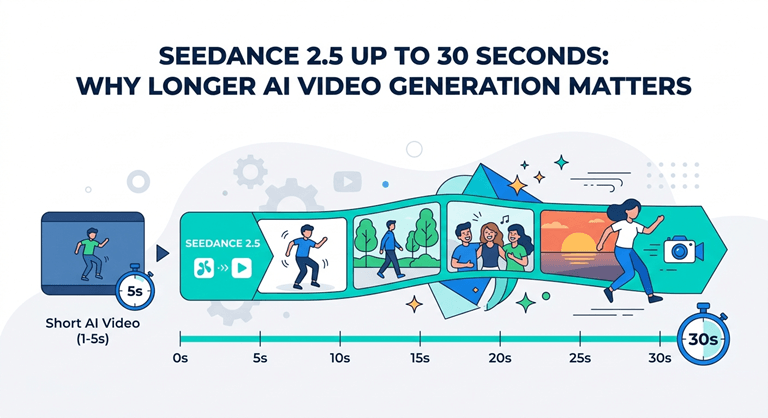
Early AI video generation tools typically produced clips of two to six seconds. That is enough for a quick visual effect or a looping background, but not enough to tell a story, deliver a message, or hold attention. To make anything longer, creators had to generate several short clips and stitch them together.
Stitching introduces problems. Sometimes the lighting changes from one clip to another, the characters’ appearance may change slightly, the movement is not smooth, and the cuts might be cut too sharply. The viewer feels that something is wrong, but doesn’t know what. While it was technically feasible to create long-form AI videos, they often appeared disjointed and choppy.
What “Up to 30 Seconds” Actually Means
The Seedance 2.5 will produce up to 30 seconds without stitching, natively. The model remains the same throughout the entire clip; it is one character, one lighting, one style,e and a smooth transition between the first and last frames.
Thirty seconds is not a random number. It fits in with the typical length of a social media ad, a product teaser, or a short narrative beat. In other words, Seedance 2.5 generates clips from the length of the content as it is actually created and not from a set of pieces that have to be put together.
Why Longer Clips Change Everything
Duration is not just a convenience. It reshapes what kinds of content are possible and how efficiently they can be made.
Storytelling needs room to breathe.
A story should include a setup, a move, and a pay-off. You can display an image in three seconds, and you can display a beginning, middle, and end in thirty. Trunklong clips allow creators to set up a scene, add movement or emotion,s and end it; this is the basic grammar of storytelling. That is what makes cinematic AI videos appear like movies instead of moving thumbnails.
Ads work better at natural length.ths
There are a number of formats for advertising, and numerous formats are designed around the 15-30 second timeframe. This length teaser can be inserted directly into a campaign without having to edit it. Marketers can create full ad concepts rather than just individual shots, resulting in a much quicker and streamlined creative process.
Fewer seams, more polish
Since the entire clip is produced in one, there are no stitching artifacts. Uniformity over 30 seconds indicates that it has been deliberate and professional. The viewer remains in the scene and is not drawn out by a blatant cut.
Consistency Is the Hard Part
Creating a long clip isn’t just a case of running a short clip for a longer period. The key is maintaining consistency over time. The face of a character must remain consistent, the light can’t change, objects can’t move in and out for hundreds of frames, and motion must follow a believable sense of physics throughout the hundreds of frames.
This is where the longer the native generation is. With a higher prompt adherence rate, according to ByteDance (which is around 20 percent higher than Seedance 2.5), you’re guaranteed the output will stay aligned with your instructions throughout the entire process. Native audio synchronisation adds yet another level of cohesion in that sound and action are created at the same time, not added on later.
Practical Uses for 30-Second AI Video
The 30-second jump allows the creation of a broad spectrum of real applications. Social media producers can develop and make full-length videos in one generation. Brands can create product teasers and ads that will fit into standard slots. Teachers may develop explainer clips of any length to explain an idea. Previsualize scenes or create stylized short-length movies for independent filmmakers. In fact, musicians can create visualisers that can last from the length of a hook or a verse.
In each instance, the extra seconds are not only the value, but also that the content is usable without the patchwork, which might have been needed with shorter tools. This is the practical promise of long-form AI video generation.
How to Make the Most of Longer Clips
For successful outcomes with longer AI-generated video content, visualize the video as a miniature narrative: sketch out the beginning, the changes, and the end. Be specific about the direction of the camera and the pacing to get 30 seconds to count. Lock in a consistent style and subject by using reference inputs, and preview the flow with the 3D white-box to make sure the look is the way you want it—before investing time in a full render. If you just want “a long video” at the end of the story, you will get much more interesting results by thinking about a beginning, middle, and end.
Frequently Asked Questions
Can Seedance 2.5 really generate 30 seconds in one clip?
Yes. Seedance 2.5 may generate up to 30 seconds of continuous video in one native clip—no “stitching” multiple short clips together.
Why is generating longer videos so difficult for AI?
But it’s the consistency that is the problem. The model should maintain the characteristics, lights, style, and movement over hundreds of frames, as well as respecting real-world physics. It is much more difficult to keep that coherence for 30 seconds as compared to a few seconds.
Is a stitched-together clip the same as a native 30-second generation?
No. Stitched clips are made of multiple generations and may result in visible cuts, light variations, and inconsistent characters. The whole clip is generated in 30-second chunks from Native 30s.
What can I actually make with 30 seconds of AI video?
Social ads, product teasers, short narrative scenes, explainer segments, and music visualizers are all examples of formats that are short enough to be presented in a clip format alone, but would not work without it.
Does the longer length reduce video quality?
Native 4K resolution and 10-bit color all the way through the clip means that no loss of quality for longer duration.
Conclusion
Being able to make AI-generated videos in just 2.5 to 30 seconds sounds like a relatively low bar, but it takes one of the main hurdles that limited AI video from the past. The model creates half a minute of consistent and native, high-quality footage in one shot, giving creators the ability to tell a real story, produce a complete ad, and produce polished content without stitching pieces together. It is because length is what makes an AI video into a finished product, so much so that it’s what makes this upgrade so important.
Popular on OTW Right Now!



About The Author

Gagan Bhangu
Founder of otechworld.com and managing editor. He is a tech geek, web-developer, and blogger. He holds a master's degree in computer applications and making money online since 2015.